

The fish we cannot catch
On nets, boundaries, and the patients who slip through

I am talking with a doctor who develops drugs for patients that big companies will never be able to help. She states this as a self-evident fact. She used to be frustrated, but now she seems indifferent, as if she has simply accepted it.
“These are the patients that no one cares about. Well, apart from their parents.”
Developing a new drug is expensive, and large pharmaceutical companies cannot afford to spend hundreds of billions on developing treatments for ultra-rare diagnoses that affect only a few dozen patients worldwide. The revenues generated are simply too small. The system is broken, especially for conditions that hardly any clinician has even heard of. Yet, those are precisely the patients she wants to help. And it gets me thinking about fish.
Many years ago, someone asked me a question:
“I’m out on a boat. I cast a net and catch a number of fish. The net is the scientific method, and the fish are knowledge. But what are the fish that my net cannot catch?”1
The question stuck with me. We have to draw boundaries around concepts for them to be useful. Clear definitions facilitate communication. However, all important concepts are inherently complex, and therefore meaningful things will inevitably end up on the outside of the definition. Those are the ones we fail to catch.
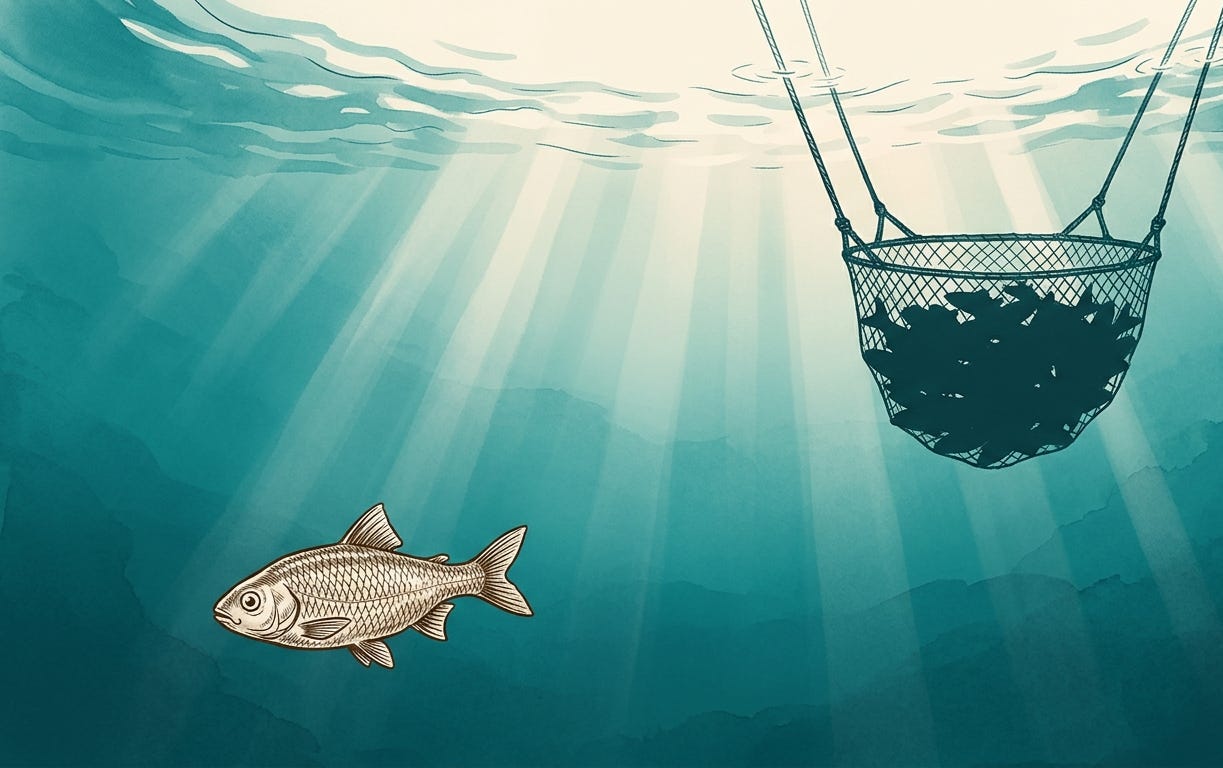
The pharmaceutical industry has produced miraculous treatments: tyrosine kinase inhibitors for chronic myeloid leukaemia, proton pump inhibitors for peptic ulcers, antibiotics and much more. The list is as long as the years of lifespan humanity has gained in the past century. Humanity has built a machinery of progress for most of what ails us. However, none of that matters to the millions of people worldwide living with an ultra-rare condition. They swim past the net at the mouth of the machinery, unnoticed.
We also have nets that define what health care is responsible for. Many important fish are never caught, even though the health care net becomes larger and finer-meshed each year. The social determinants of health are the most significant influence on how long and how well we live, yet many of these determinants fall outside the scope of health care. There are good reasons for that. Different waters and different fish require different nets. Creating one net for all types of fish would be difficult and costly, which means that some important fish remain outside it. Similarly, it would be just as difficult and expensive to establish a health care system capable of encompassing education, housing, and culture, which is why certain important factors must remain outside of health care.
And we also have nets for what counts as good care. We measure healthcare-associated infections, bed days, accessibility, patient satisfaction, and many other metrics. However, the unique, unmeasurable aspects that matter most to an individual’s quality of life often slip through these nets. They don’t show up in our data, and we rarely have the time or resources to understand them. Clear boundaries make communication easier. The nets allow us to coordinate, capture, and measure, but sometimes they miss the point entirely.
I can’t fish. A friend once took me out on a fishing trip, and my expectations were high. I read up beforehand and pictured us coming home with a full box of fish. But, as mentioned, I can’t fish. After spending several hours by the water, we ended up eating something out of his freezer that evening. It was a quiet and lovely afternoon all the same.
Now, I should be careful about offering advice on fishing nets, having fished exactly once and achieved a hundred percent failure rate. I never did learn to fish. However, I did learn that precise definitions have their limits. Sometimes, the fish we cannot catch matter just as much as the ones that end up in the net.
This column was originally published in the Swedish Medical Journal, Läkartidningen, here
You may recognize this as an modified version of Arthur Eddington’s fisherman's net parable from The Philosophy of Physical Science (from 1938, when calling someone a metaphysician was the worst insult imaginable):
Let us suppose that an ichthyologist is exploring the life of the ocean. He casts a net into the water and brings up a fishy assortment. Surveying his catch, he proceeds in the usual manner of a scientist to systematise what it reveals. He arrives at two generalisations: No sea-creature is less than two inches long. (2) All sea-creatures have gills. These are both true of his catch, and he assumes tentatively that they will remain true however often he repeats it.
In applying this analogy, the catch stands for the body of knowledge which constitutes physical science, and the net for the sensory and intellectual equipment which we use in obtaining it. The casting of the net corresponds to observation; for knowledge which has not been or could not be obtained by observation is not admitted into physical science.
An onlooker may object that the first generalisation is wrong. "There are plenty of sea-creatures under two inches long, only your net is not adapted to catch them." The icthyologist dismisses this objection contemptuously. "Anything uncatchable by my net is ipso facto outside the scope of icthyological knowledge. In short, "what my net can't catch isn't fish." Or -- to translate the analogy -- "If you are not simply guessing, you are claiming a knowledge of the physical universe discovered in some other way than by the methods of physical science, and admittedly unverifiable by such methods. You are a metaphysician. Bah!"